Ammonia (derived from the French word ammonia /amɔnjak/), [1] is also written as ammonia , [1] is a combination of nitrogen and hydrogen with the chemical formula NH 3 . Ammonia, as a stable double hydride and the simplest penictogen hydride , is a colorless gas with a characteristic pungent odor (smell). It is a common nitrogenous waste, especially among aquatic organisms, and fulfills the nutritional needs of terrestrial organisms by acting as a precursor andManure helps. Bar, directly or indirectly, is also a building block for the synthesis of many pharmaceutical products and is used in many commercial cleaning products. It is mainly collected by low-level synthesis of air and water.
Although it is both corrosive and dangerous and widely used in nature – both on land and on extrasolar planets – ammonia in its concentrated form is a very dangerous substance . This substance is classified in the United States and is subject to strict reporting requirements by facilities that produce, store, or use it in significant quantities. [2]
The global production of industrial ammonia in 2018 was 175 million tons, [3] which was not significantly changed from the global industrial production of 175 million tons in 2013. [4] Industrial ammonia is sold as ammonia alcohol (usually 28% ammonia in water) or as pressurized or refrigerated liquid ammonia shipped in tank trucks or cylinders . [5]
NH 3 boils at -33.34 at standard pressure , so the liquid must be stored under pressure or at low temperature. Household ammonia or ammonium hydroxide is a solution of NH3 in water. The concentration of these solutions is measured in units of the Baume scale ( specific gravity ), with 26 °Baume (about 30 percent (by weight) ammonia at 15.5 °C or 59.9 °F) as the product. Typical commercial products with high concentration. From this article [6]
Morphophonemics
XXXI Pliny himself, in his Natural History , mentions salt produced in the Roman province of Cyrenaica as hammoniacum , so called because it was located near the temple of Jupiter Ammon ( Greek: Ἄμμων Ammon ). [7] However, Pliny’s description of the salt does not match the properties of ammonium chloride. According to Herbert Hoover in the English translation of De re metallica by Agricola , this could be common sea salt. [8] Compounds in any case, that salt eventually gave rise to the name ammonium and ammoniumbecame .
It occurs in nature
Ammonia is a chemical substance that is found in small amounts in nature and is produced from plant and animal nitrogenous substances. Ammonia and ammonium salts are also found in small amounts in rainwater, while ammonium chloride (ammonium sal) and ammonium sulfate are found in volcanic regions. Ammonium bicarbonate crystals have been found in the feces of Patagonian birds . [9] The kidneys secrete ammonia to neutralize excess acid. [10] Ammonium salts are found in fertile soils and in seawater.
Ammonia is also found throughout the planets of the Solar System on Mars , Jupiter , Saturn , Uranus , Neptune and Pluto , and elsewhere: on smaller planets such as Pluto, ammonia can act as an important geological antifreeze, as a mixture of if At high enough ammonia concentrations, water and ammonia can have melting temperatures of up to 173 K (−100 °C; −148 °F), thus allowing such bodies to form geologically active and inland oceans at temperatures much lower than what is about to maintain. with only water planets [11] [12]Substances containing ammonia, or its analogues, are called ammonia .
Physical properties
Ammonia is a colorless gas with a pungent smell. It is lighter than air and its density is 0.589 times that of air . It is easily liquefied due to strong hydrogen bonds between molecules . The liquid boils at -33.3 °C (-27.94 °F) and freezes into white crystals at -77.7 °C (-107.86 °F) .
Ammonia can be easily deodorized by reacting with sodium bicarbonate or acetic acid . Both of these reactions form odorless ammonium salts.
- Solids
Crystal symmetry is cubic, Pearson symbol cP16, space group P2 1 3 (№. 198), lattice constant 0.5125 nm .
- liquid
Liquid ammonia has a strong ionization potential due to its high ε- index of 22. Liquid ammonia has a very high standard enthalpy change of vaporization (23.35 kJ /mol, water 40.65 kJ/mol). mol, methane 8.19 kJ/mol, phosphorus 14.6 kJ/mol) and can therefore be used in the laboratory in uninsulated flasks without further cooling. Consider liquid ammonia as a solvent.
- Solvent properties
Ammonia dissolves easily in water. In aqueous solution, it can be removed by boiling. Aqueous solutions are basic ammonia . The maximum concentration of ammonia in water ( saturated solution ) has a density of 0.880 grams per cubic centimeter, and it is usually called “880 ammonia”.
- in fire
Ammonia does not burn immediately or can sustain combustion , except when the fuel-air mixture is thin and contains 15-25% air. When mixed with oxygen , it burns with a greenish-yellow flame. Ignition occurs when chlorine is injected with ammonia and nitrogen and hydrogen chloride are formed. If excess chlorine is present, the highly explosive nitrogen trichloride (NCl 3 ) is also formed.
- analysis
At high temperature and in the presence of a suitable catalyst, ammonia breaks down into its constituent elements. Ammonia decomposition is a mildly endothermic process that requires 5.5 kcal/mol of ammonia and produces hydrogen and nitrogen gas. If ammonia is removed without reaction, ammonia can be used as a hydrogen source for acidic fuel cells. The ruthenium and platinum catalysts were found to be the most active, while the supported nickel catalysts were less active.
Structure
The ammonia molecule has a trigonal pyramidal shape predicted by the valence layer electron pair repulsion theory (VSEPR theory) with an experimentally determined bond angle of 106.7°. [13] The central nitrogen atom has five outer shell electrons with an additional electron from each hydrogen atom. This produces a total of eight electrons or four pairs of electrons arranged in a tetrahedron. Three of these electron pairs are used as bonding pairs, leaving one lone pair of electrons . The lone pairs are more strongly repelled than the bond pairs, so the bond angle is not 109.5°, as expected for a regular tetrahedral arrangement, but 106.7°. [13] This shape gives the molecule a dipole moment and itIt polarizes . The polarity of the molecule and especially its ability to form hydrogen bonds make ammonia highly miscible with water. The lone pair converts ammonia into a base , a proton acceptor. Ammonia is relatively basic. A 1.0 M aqueous solution has a pH of 11.6, and if a strong acid is added to such a solution to make the solution neutral (pH = 7), 99.4% of the ammonia molecules are removed. Protonation . Temperature and salinity of NH4 + also affect the ratio. The latter has the shape of a regular tetrahedron and is isoelectronic with methane .
Ammonia molecule easily undergoes nitrogen inversion at room temperature. A useful analogy is an umbrella that appears in a strong wind. The energy barrier for this inversion is 24.7 kJ/mol and the resonance frequency is 23.79 GHz , which corresponds to microwave radiation with a wavelength of 1260 cm. Absorption at this frequency was first observed in the microwave spectrum.
bisexuality
One of the most obvious properties of ammonia is its playfulness . Ammonia is considered a weak base. It combines with acids and forms salt . Therefore, with hydrochloric acid, it forms ammonium chloride (ammonium salt). It does not combine with nitric acid to form ammonium nitrate , etc. Completely dry ammonia with completely dry hydrogen chloride . Moisture is needed to carry out the reaction. [14] [15]As a descriptive experiment, opened bottles of concentrated ammonia and hydrochloric acid produce a “cloud” of ammonium chloride that appears when the salt meets where the two diffuse molecular clouds meet, somewhere between the two bottles, from “no appear.
Salts formed by the action of ammonia with acids are called ammonium salts and all contain ammonium ions (NH 4 + ). Although ammonia is known as a weak base, it can also act as a very weak acid. The substance is protonated and is able to form amides (containing NH 2 ions – this one ). For example, lithium dissolves in liquid ammonia to give a solution of lithium amide :
chemical properties
In ammonia, nitrogen has the lowest oxidation number , so ammonia is reducing. For example, in a chemical reaction:
- 2 NH 3 + 3 Cl 2 ⟶ N 2 + 6 HCl
- 4 NH 3 + 3 O 2 → 500 o C 2 N 2 + 6 H 2 O

![{\displaystyle {\ce {4NH3 + 3O2 ->[500^o C] 2N2 + 6H2O}}} { \](https://wikimedia.org/api/rest_v1/media/math/render/svg/24713424b16a6d0cb2f68374c1c5a0f360121f09)
Alkali metal or aluminum atom:
- 2 NH 3 + 2 before, before → 350 o C 2 NANH 2 + H 2
- 2 NH 3 + 2 AL → 800-900 o C 2 AlN + 3 H 2 _ _
![displaystyle {\ce {2NH3 + 2Na ->[350^o C] 2NaNH2 + H2))}](https://wikimedia.org/api/rest_v1/media/math/render/svg/e34b4c906c4f4889ec830f56054d37a9e6363060)
![{\displaystyle {\ce {2NH3 + 2Al ->[800-900^o C] 2AlN + 3H2))} { \](https://wikimedia.org/api/rest_v1/media/math/render/svg/375054d38ad80d520769fdc6ebd0e7cf606f25bd)
Effect of salt solution:
- 3 NH 3 + AlCl 3 + 3 H 2 O ⟶ Al ( OH ) 3 + 3 NH 4 Cl

Poor basic calculation
Soluble in water
According to Brønsted-Lowry theory , when NH 3 is dissolved in water, a small part of ammonium molecules combine with H + ions of water and form the ammonium cation NH 4 + , and OH – acts as a free anion . They do, this time water as an acid .
- NH 3 + H 2 O ↽ – – ⇀ NH 4 + + Oh – \]

The OH- ion plays the solution , but compared to strong alkaline solutions (such as caustic soda , potato , lime water in …) with the same concentration, the concentration of OH- formed by ammonia is much lower . Due to its alkalinity, ammonia solution turns blue to litmus red and phenolphthalein solution turns from colorless to pink. Therefore, to detect ammonia, wet purple litmus is used to detect this gas.
Reaction with acids

Ammonia (in gas as well as solution) readily neutralizes acids and forms ammonium salts. Example:
- 2 NH 3 + H 2 so 4 ⟶ ( NH 4 ) 2 so 4

Alfalfa
- NH 3 + H + ⟶ NH 4 +

When two base flasks containing a concentrated HCl solution and a nearby NH3 solution were placed together , a white “smoke” was formed (Figure 1). Since HCl and NH3 are volatile compounds, they combine to form ammonium chloride salt crystals, which results in the “smoke” phenomenon.
- NH 3 ( k ) + HCl ( k ) ⟶ NH 4 Cl ( r )

This reaction is used to detect ammonia gas.
Effects with salt solutions
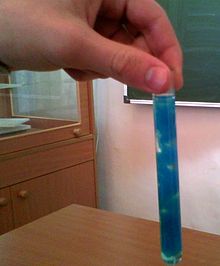
Ammonia solution has the ability to precipitate many metal hydroxides during the reaction
For example, in Figure 2, the ammonia solution reacts with the copper (II) sulfate solution to form an aqueous precipitate:
- NH 3 + H 2 O + CuSO 4 ⟶ ( NH 4 ) 2 So 4 + Cu ( Oh ) 2 ↓

The possibility of creating a complex
Ammonia solution has the ability to form complexes with many insoluble compounds of metals such as copper , silver , nickel , lead , zinc , etc.
Since these cations have an empty orbital, they can accept a pair of non-bonding electrons in the N NH 3 atom .
- M ( OH ) 2 + 4 NH 3 ⟶ [ M ( NH 3 ) 4 ] ( OH ) 2 (with M = copper, zinc, lead,…)
- which in ( OH ) 2 + 6 NH 3 ⟶ [ which in ( NH 3 ) 6 ] ( OH ) 2
- Ag + + 2 NH 3 ⟶ [ Ag ( NH 3 ) 2 ] +
2}}} {\displaystyle {\ce {Ni(OH) 2 + 6NH3 -> [Ni(](https://wikimedia.org/api/rest_v1/media/math/render/svg/161640ee3e29c23b3c2fc7c5db961cfa230f0cc4)

![{\displaystyle {\ce {Ag+ + 2NH3 -> [Ag(NH3)2]+}}}](https://wikimedia.org/api/rest_v1/media/math/render/svg/6a54fcb6a7a78659b60e2e2e3fccb837b0a11a7c)
modulation
In the laboratory: 2 NH 4 Cl + about ( oh ) 2 ⟶ NH 3 + CaCl 2 + H 2 O

in industry:
Most NH3 ( 90 %) by Haber – Bosch method with N2 from air , H2 from methane ( CH4 ) and water .


- CH 4 + H 2 O ↽ – – ⇀ CO + 3 H 2 (nickel catalyst, high temperature) N 2 + 3 H 2 ↽ – – ⇀ 2 NH 3 (ΔH = -92 kJ/mol)


The hyperreversible and exothermic reaction is slow to shift the equilibrium to the right side , so there must be suitable conditions so that according to Le Chatelier’s principle , The atmosphere is catalyzed by a mixture of Fe , Al2O3 , 200-300 , etc. , K2O . In fact, this reaction usually takes place at a temperature of 450-500 degrees Celsius , but the yield is only 20-25%. CaCN 2 Rothe-Frank-Caro method :
- CaCN 2 + 3 H 2 O ⟶ CaCO 3 + 2 NH 3

Persk method of aluminum nitride AlN and water:
- 2 AlN + 3 H 2 O ⟶ Al 2 O 3 + 2 NH 3

From NO and H 2 :
- 2 NH + 5 H 2 ⟶ 2 NH 3 + 2 H 2 O

Dehydrogenation with nitrogen (in English: hydrodenitrogenation)
- 3 H 2 + R 3 N ⟶ 3 R – H + NH 3

Currently, several laboratory studies show that ammonia is produced directly from nitrogen and water in the presence of titanium(IV) oxide catalysts and UV light :
- 2 N 2 + 6 H 2 O ⟶ 4 NH 3 + 3 O 2

Program
The main uses of ammonia are the preparation of nitrogen fertilizers , the preparation of nitric acid as a solder and the production of hydrazine N 2 H 4 , which is used as a fuel for rockets. In addition, ammonia solution is also used as a household cleaner.
the danger
If you inhale too much ammonia, it will burn your airways (throat) . Ammonia gas inhibits the nervous system and creates a feeling of irritability. Symptoms: cough, chest pain (severe), angina pectoris, shortness of breath, rapid breathing, wheezing, shortness of breath, coughing up blood, convulsions with the following manifestations:
- Eyes, mouth, throat: watery eyes and burning eyes, blindness, severe sore throat, mouth pain, cleft lip.
- Cardiovascular: fast, weak pulse, shock.
- Nervous: confusion, difficulty walking, dizziness, lack of coordination, restlessness, lethargy.
- Skin: pale green lips, severe burns with prolonged exposure.
- Stomach and digestive system: severe stomach pain, vomiting.