Polystyrene was first produced in Germany by IG Farbenindustrie in 1930. The most widely used manufacturing process today is “mass polymerization”, with emulsion and solution processes having become obsolete.
The polymerization of pure styrene results in pure polystyrene which is a colorless, rigid, brittle solid with limited flexibility. This pure polystyrene is called “ crystal polystyrene ” or “ general purpose polystyrene ” ( GPPS ). Below 95 ºC (glass transition temperature of polystyrene), crystal polystyrene is glassy, above this temperature it is softer and can be molded.
A new kind of polystyrene has recently been developed, called syndiotactic. It is different because the phenyl groups of the polymer chain are attached alternately to both sides of the chain. “Normal” polystyrene or atactic polystyrene does not maintain any order with respect to the side of the chain where the phenyl groups are attached. The “new” polystyrene is crystalline and melts at 270 ºC, but it is much more expensive. It is only used in special applications with high added value.
Another material in this family is “expanded polystyrene” (EPS). It consists of 95% polystyrene and 5% of a gas that forms bubbles that reduce the density of the material. Its main application is as insulation in construction and for packaging fragile products. The density is 1.06 g/cm3.

The main advantages of polystyrene are its ease of use and its relatively low cost. Its main disadvantages are its low resistance to high temperatures (atactic PS) (it deforms at less than 100°C) and its modest mechanical strength. These advantages and disadvantages determine the applications of the different types of polystyrene.
Styrene copolymers
Pure polystyrene is brittle but hard enough that a relatively high-performance product can be produced by transferring some of the properties of a more elastic material. This is why it is mixed with a bit of rubber, usually polybutadiene rubber, during polymerization.
Under normal conditions polystyrene and polybutadiene cannot be mixed, which is why styrene, polybutadiene (or other rubber), catalyst and accelerator are mixed during polymerization.
The product resulting from this mixture of polystyrene with polybutadiene grafts is called “ high-impact polystyrene ” ( HIPS ) or “ shock polystyrene ”.
Acrylonitrile-butadiene-styrene terpolymer, known as ABS plastic , is similar to high-impact polystyrene. It is a copolymer of acrylonitrile and styrene but hardened with polybutadiene. It is a heterogeneous material formed by a rigid homogeneous phase and an elastomeric phase.
Obtaining
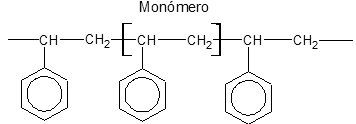
Polystyrene is a polymer obtained by a process called polymerization , which consists of joining many small molecules to obtain very large molecules. The substance obtained is a polymer and the simple compounds from which they are obtained are called monomers .
The monomer used as a base in obtaining polystyrene is styrene ( vinylbenzene): C 6 H 5 – CH = CH 2
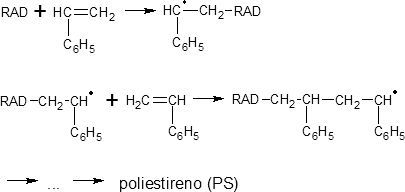
On an industrial scale, polystyrene is prepared by heating ethylbenzene ( C6H5 – CH2 – CH3 ) in the presence of a catalyst to give styrene ( C6H5 – CH=CH2 ) . The polymerization of styrene requires the presence of a small amount of an initiator, including peroxides, which acts by breaking down to generate a free radical. This binds to a monomer molecule, thus forming a larger free radical, which in turn binds to another monomer molecule, and so on. Finally the chain is terminated by reactions such as the union of two radicals, which consume but do not generate radicals.
Properties
It should be noted that, in addition to the covalent bonds that hold the monomer molecules together, other intermolecular and intramolecular interactions often occur that significantly influence the physical properties of the polymer, which are different from those of the starting molecules. Polystyrene, in general, has elasticity, a certain resistance to chemical attack, good mechanical, thermal and electrical resistance and low density.
Polystyrene is a thermoplastic polymer . In these polymers, the intermolecular forces are very weak and when heated, the chains can move relative to each other and the polymer can be moulded. When the polymer cools, the intermolecular forces are re-established but between different atoms, which changes the order of the chains.
Polystyrene transformation and applications
The most commonly used transformation techniques in the transformation of plastics are:
Extrusion: The polymer is heated and forced by a screw and passes through a tube-shaped orifice. Pipes, profiles, beams and similar materials are produced by extrusion.
Injection: The polymer is melted using heat and friction and introduced into a cold mould where the plastic solidifies. This method is used to manufacture objects such as pens, kitchen utensils, toys, etc.
Blow-moulding : First, a plastic tube is extruded and inserted into a mould that closes around the plastic. Air is then introduced into the plastic tube, which is forced to take the shape of the mould. This is how plastic bottles are obtained.
High-impact polystyrene is mainly used in the manufacture of objects by injection moulding. Depending on the application, additives such as fire-retardant substances or colourants can be added.
Crystal polystyrene is also used in injection moulding where transparency and low cost are important. Another very important application is in the production of foams, sometimes called XPS, not to be confused with expanded polystyrene EPS. These foams are used for example for meat trays in supermarkets, as well as in construction.
The expanded form (expanded polystyrene) is used as thermal and acoustic insulation and is widely known under various trade names (Poliexpan or porexpán, Telgopor, etc.)
|
MANUFACTURING METHOD
|
USES
|
|---|---|
| Injection molding | Toys Radio and television housings Car parts Medical instruments Household items Bottle caps Containers |
| Blow molding | Bottles Containers Car Parts |
| Extrusion | Protective films General profiles Light reflectors Construction covers |
| Extrusion and thermoforming | Refrigerator interiors Luggage Food packaging Disposable services Large automotive structures |
Food packaging: One of the largest consumptions of polystyrene is in everything related to food packaging; it is very common to see it in pots of dairy products (yogurt, cheese, sweets, etc.) as well as in trays, containers and cases in fast food restaurants. They can be transparent, colored, foamed or expanded. OPS (biaxially oriented polystyrene) is also widely used in these applications due to its excellent crystallinity and shine, which enhances the appearance of the products inside the container.
Tableware and bazaar : Disposable tableware, plates, trays, glasses, cutlery, etc. Tableware for airplanes and bazaar items of all kinds.
Household appliances – Electronics : Within the household appliances sector, it is important to use it in refrigeration: for interior panels of refrigerators, trays and interior crispers. It is also used in television and audio.
Others: Cosmetics, toys, footwear, insulating panels for construction, fruit separators, etc.