Polypropylene is a semi-crystalline thermoplastic, which is produced by polymerizing propylene in the presence of a specific stereo catalyst. Polypropylene has multiple applications, which is why it is considered one of the thermoplastic products with the greatest development in the future. It is an inert product, fully recyclable, its incineration has no polluting effect, and its production technology has the lowest environmental impact. This is an attractive feature compared to alternative materials.
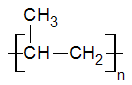
The catalytic polymerisation of propylene was discovered by the Italian Giulio Natta in 1954 and marked a significant milestone both for its scientific interest and for its important applications in the industrial field. Using selective catalysts, a crystalline polymer was obtained, formed by the ordered alignment of propylene monomer molecules. The high reaction yields allowed its rapid commercial exploitation. Although polypropylene was made known through patents and
Polypropylene is a semi-crystalline thermoplastic, which is produced by polymerizing propylene in the presence of a specific stereo catalyst. Polypropylene has multiple applications, which is why it is considered one of the thermoplastic products with the greatest development in the future. It is an inert product, fully recyclable, its incineration has no polluting effect, and its production technology has the lowest environmental impact. This is an attractive feature compared to alternative materials.
The catalytic polymerisation of propylene was discovered by the Italian Giulio Natta in 1954 and marked a significant milestone both for its scientific interest and for its important applications in the industrial field. Using selective catalysts, a crystalline polymer was obtained, formed by the ordered alignment of propylene monomer molecules. The high reaction yields allowed its rapid commercial exploitation. Although polypropylene was made known through patents and publications in 1954, its commercial development began in 1957 and was due to the Italian company Montecatini. A few years later, other companies, including ICI and Shell, also manufactured this polyolefin.
This discovery boosted research into stereospecific catalytic systems for the polymerization of olefins and earned Natta, together with the German Karl Ziegler, the Nobel Prize in Chemistry in 1963.
Today, polypropylene is one of the most widely sold thermoplastics in the world, with an estimated annual demand of 40 million tons. Its annual consumption increases have been close to 10% over the last decades, confirming its degree of acceptance in the markets.
The good reception it has had has been directly related to its versatility, its good physical properties and the economic competitiveness of its production processes. Several strong points confirm it as an ideal material for many applications:
- Low density
- High hardness and abrasion resistant
- High rigidity
- Good heat resistance
- Excellent chemical resistance
- Excellent versatility
Due to its excellent price-performance ratio, polypropylene has gradually replaced materials such as glass, metals and wood, as well as widely used polymers (ABS and PVC).
The world’s major oil companies produce polypropylene, either through direct participation or through subsidiaries. Over the past few years, the volume of polypropylene business has grown significantly, both worldwide and within the group.
Structure of polypropylene
Structurally, it is a vinyl polymer, similar to polyethylene, except that one of the carbons of the monomeric unit has a methyl group attached.
Industrially manufactured polypropylene is a linear polymer with a backbone consisting of a chain of saturated hydrocarbons. Every two carbon atoms in this main chain is branched by a methyl group (CH 3 ). This allows us to distinguish three isomeric forms of polypropylene:

Isotactic

Syndiotactic

Atactic
These are differentiated by the position of the methyl-CH 3 groups with respect to the spatial structure of the polymer chain.
Isotactic and syndiotactic forms, given their great regularity, tend to acquire an ordered, semi-crystalline spatial arrangement in the solid state, which gives the material exceptional physical properties. The atactic form, on the other hand, does not have any type of crystallinity. The most commonly used industrial processes are directed towards the manufacture of isotactic polypropylene, which is the one that has aroused the greatest commercial interest.
Reaction mechanism
Propylene polymerization is an addition reaction that uses coordination catalysts. These are transition metal compounds that, through metal-carbon bonds, allow the insertion of monomer units. One of the first systems developed was of the TiCl 4 /A 1 ,R 3 type . Although catalytic systems have evolved significantly since then and their performance has increased dramatically, the operating principle of all of them is very similar.
The reaction mechanisms of the catalytic system are those that explain the linear structure of the polypropylene molecule. Although some details are still debated, most researchers agree that the initiation of the reaction is given by the activation of the catalytic system according to a model described in detail by Cossee and Arlman. Once the active sites have been created, the polymer chains grow in successive stages on the catalyst, by forming a coordination complex between the propylene monomer molecule and a vacant coordination box. The reaction is usually terminated by transfer, thanks to the action of agents such as hydrogen. The use of these agents is quite useful to control the average length of the polymer chains formed and, therefore, their molecular weight, their melt viscosity, etc.
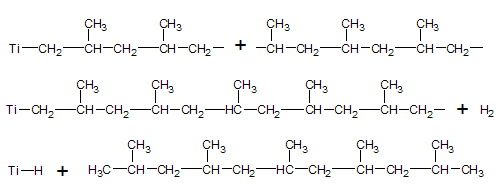
The reaction is highly regio-selective, meaning that the monomer chains are incorporated into the main chain forming well-defined configurations (isotactic, syndiotactic or atactic). The introduction of electron-donating compounds often creates aesthetically bulky clusters around the active sites of the catalyst, so the formation of one of the configurations is usually favoured (usually the isotactic one).
If only propylene monomer is introduced during polymerization, a homopolymer is obtained. If a second monomer (or comonomer) is introduced together with propylene, a copolymer is obtained. The most widely used comonomer is ethylene. There are two types of copolymers: random copolymers (where the monomer and comonomer react simultaneously) and block or heterogeneous copolymers (where the monomer and comonomer are introduced in two successive stages).
The world of polypropylene is currently undergoing a revolution with the industrial development of a new generation of catalysts: metallocenes. This is a new family of organometallic compounds that control with greater precision the regularity of the structure of the polymer formed and its molecular weight distribution. The products thus obtained will have differentiated properties that can complement the current range.
in 1954, its commercial development began in 1957 and was due to the Italian company Montecatini. A few years later, other companies, including ICI and Shell, also manufactured this polyolefin.
This discovery boosted research into stereospecific catalytic systems for the polymerization of olefins and earned Natta, together with the German Karl Ziegler, the Nobel Prize in Chemistry in 1963.

Today, polypropylene is one of the most widely sold thermoplastics in the world, with an estimated annual demand of 40 million tons. Its annual consumption increases have been close to 10% over the last decades, confirming its degree of acceptance in the markets.
The good reception it has had has been directly related to its versatility, its good physical properties and the economic competitiveness of its production processes. Several strong points confirm it as an ideal material for many applications:
- Low density
- High hardness and abrasion resistant
- High rigidity
- Good heat resistance
- Excellent chemical resistance
- Excellent versatility
Due to its excellent price-performance ratio, polypropylene has gradually replaced materials such as glass, metals and wood, as well as widely used polymers (ABS and PVC).
The world’s major oil companies produce polypropylene, either through direct participation or through subsidiaries. Over the past few years, the volume of polypropylene business has grown significantly, both worldwide and within the group.
Structure of polypropylene
Structurally, it is a vinyl polymer, similar to polyethylene, except that one of the carbons of the monomeric unit has a methyl group attached.
Industrially manufactured polypropylene is a linear polymer with a backbone consisting of a chain of saturated hydrocarbons. Every two carbon atoms in this main chain is branched by a methyl group (CH 3 ). This allows us to distinguish three isomeric forms of polypropylene:
Isotactic
Syndiotactic
Atactic
These are differentiated by the position of the methyl-CH 3 groups with respect to the spatial structure of the polymer chain.
Isotactic and syndiotactic forms, given their great regularity, tend to acquire an ordered, semi-crystalline spatial arrangement in the solid state, which gives the material exceptional physical properties. The atactic form, on the other hand, does not have any type of crystallinity. The most commonly used industrial processes are directed towards the manufacture of isotactic polypropylene, which is the one that has aroused the greatest commercial interest.
Reaction mechanism
Propylene polymerization is an addition reaction that uses coordination catalysts. These are transition metal compounds that, through metal-carbon bonds, allow the insertion of monomer units. One of the first systems developed was of the TiCl 4 /A 1 ,R 3 type . Although catalytic systems have evolved significantly since then and their performance has increased dramatically, the operating principle of all of them is very similar.
The reaction mechanisms of the catalytic system are those that explain the linear structure of the polypropylene molecule. Although some details are still debated, most researchers agree that the initiation of the reaction is given by the activation of the catalytic system according to a model described in detail by Cossee and Arlman. Once the active sites have been created, the polymer chains grow in successive stages on the catalyst, by forming a coordination complex between the propylene monomer molecule and a vacant coordination box. The reaction is usually terminated by transfer, thanks to the action of agents such as hydrogen. The use of these agents is quite useful to control the average length of the polymer chains formed and, therefore, their molecular weight, their melt viscosity, etc.
The reaction is highly regio-selective, meaning that the monomer chains are incorporated into the main chain forming well-defined configurations (isotactic, syndiotactic or atactic). The introduction of electron-donating compounds often creates aesthetically bulky clusters around the active sites of the catalyst, so the formation of one of the configurations is usually favoured (usually the isotactic one).
If only propylene monomer is introduced during polymerization, a homopolymer is obtained. If a second monomer (or comonomer) is introduced together with propylene, a copolymer is obtained. The most widely used comonomer is ethylene. There are two types of copolymers: random copolymers (where the monomer and comonomer react simultaneously) and block or heterogeneous copolymers (where the monomer and comonomer are introduced in two successive stages).
The world of polypropylene is currently undergoing a revolution with the industrial development of a new generation of catalysts: metallocenes. This is a new family of organometallic compounds that control with greater precision the regularity of the structure of the polymer formed and its molecular weight distribution. The products thus obtained will have differentiated properties that can complement the current range.